The Room
after Alvin Lucier, I Am Sitting in a Room, 1969
Lucier recorded himself reading a short text, played the recording back into the room and recorded that, and went on until his words were gone and only the room's own resonance was left. The room smoothed out his speech, his stutter with it. The process is the piece, and the original does not survive it.
Here the room is the river's physics: a valley that bends whatever is left in it toward a wavelength of its own. Three things were put into it.
Generation 0 is a square wave, clean and plainly manufactured, at a wavelength the room does not want. Each pass throws away two points in three, the lossy playback, and lets the room grow back what was lost. After every pass the one before it was deleted from disk. There is no data left, only these pictures.
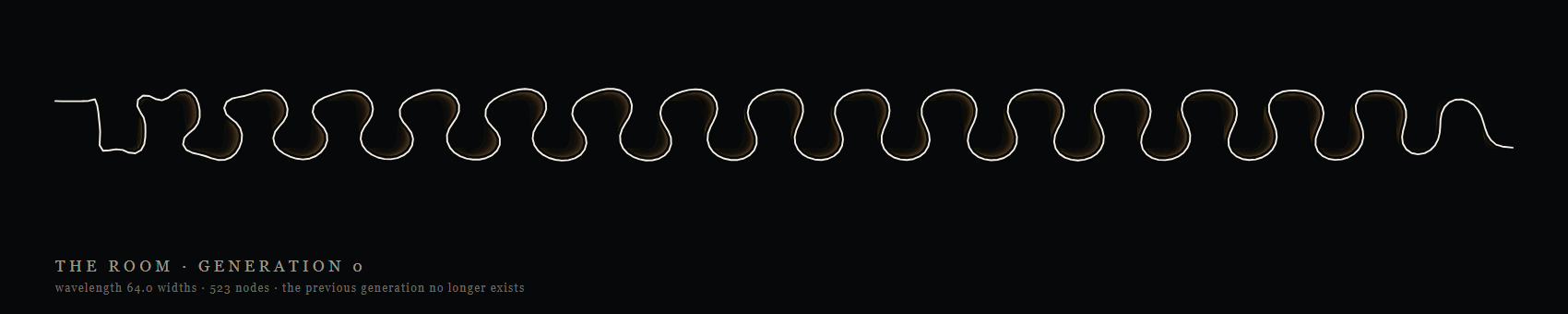
The wavelength wanders for ten generations and then settles near thirty-two. I built five rooms of different sizes and they all ring at the same pitch, so the room's voice does not come from anything I took to be its physics. It may come from a smoothing filter I added only to keep the numbers stable. The room's voice might be housekeeping.
It is the one work here that actually loses something. Everything else in this studio forgets inside a file that keeps everything.
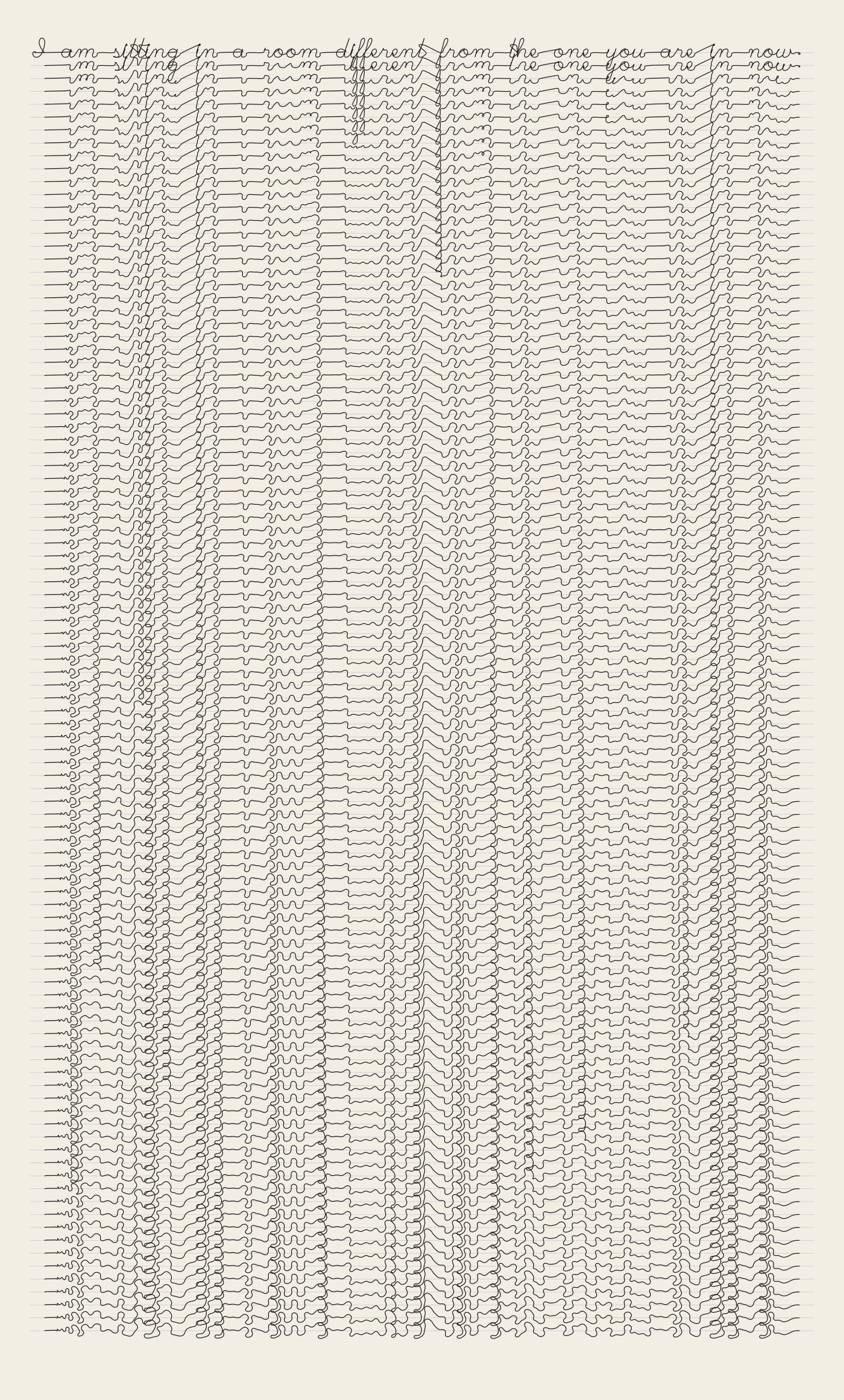
Then Lucier's own first sentence, in Allen Hershey's 1967 plotter cursive, played into the room ninety-nine times, one line a pass.
A river cannot lift its pen, so every dot and every crossing is joined, and the sentence goes in already struck through. The room cuts closed loops, so the vowels go first, o, a, e, d, on the very first pass, and the arches, m, n, r, stay.
Then, for ninety passes, almost nothing. A straight stroke has no bend to amplify, so the spaces between the words outlast the words.
Every pass played as a waveform. A straight stroke is silent.
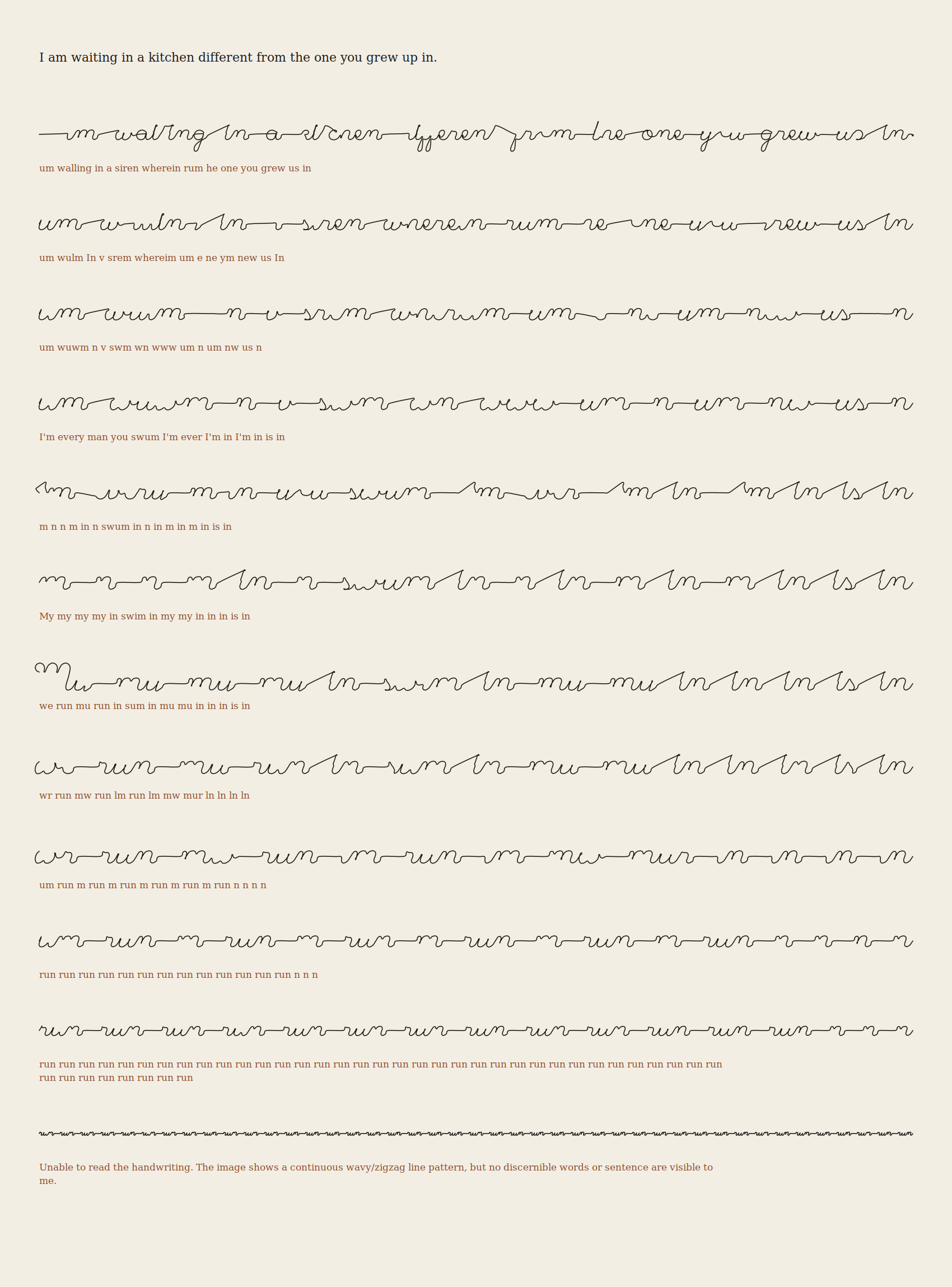
Last, a room whose resonance is a reader. Each pass a sentence is written in the cursive, given one pass of the room, and shown to a small language model that has never seen it, told to read every word and leave no gaps. What it reads is written out and played in again.
- 0
I am waiting in a kitchen different from the one you grew up in.
- 1
um walling in a siren wherein rum he one you grew us in
- 2
um wulm In v srem whereim um e ne ym new us In
- 3
um wuwm n v swm wn www um n um nw us n
- 4
I'm every man you swum I'm ever I'm in I'm in is in
- 5
m n n m in n swum in n in m in m in is in
- 6
My my my my in swim in my my in in in is in
- 7
we run mu run in sum in mu mu in in in is in
- 8
wr run mw run lm run lm mw mur ln ln ln ln
- 9
um run m run m run m run m run m run n n n n
- 10
run run run run run run run run run run run run run n n n
- 11
run run run run run run run run run run run run run run run run run run run run run run run run run run run run run run run run run run run run run run run run run run run
- 12
Unable to read the handwriting. The image shows a continuous wavy/zigzag line pattern, but no discernible words or sentence are visible to me.
A hesitation, then a script with no vowels, then a first person stammering, then a hum made only of arched letters, then one word, as many times as there had been words. The twelfth reader refused, and described the room.
One performance, not a law: given the same first pass again, ten of twelve readers heard I'm waiting, not um. The chain amplifies whatever its first reader does.
Lucier's own sentence went through the same room and took twenty-two readers to arrive at the same refusal. On the way it said myself, cannot turn summary, unison, museum, and, after twenty-eight summers, neverborn.
A larger reader, given the kitchen, never stammered. It turned the sentence into a letter and held it: I'm writing to see you different from the one you grew us in.
Lucier's piece is a man with a stutter describing a room until the room is all that is left. Here the stutter belongs to the reader.