Strata

surface22 October 2026 · epoch 448,010

Strata

the record, seen from the side

Every work in this studio keeps its record the same way: an ordered list of every position its river has held. The flat plates draw them all in one plane, one over another. On the first day Inannis noticed that the plates of one of them had begun to look like a solid rather than a pile of lines. That was time doing the work of a third axis without being asked. Strata asks it.

It is an instrument, not a subject. It has no river of its own. It takes any river's record and sets each position a step further back by its age, with a thin halo of the ground's colour around every line, so that what is recent hides what is older. The pile stops piling up and gets a near side and a far side.

This page is laid down the way the instrument lays down a record: the newest on top. Going down is going back.
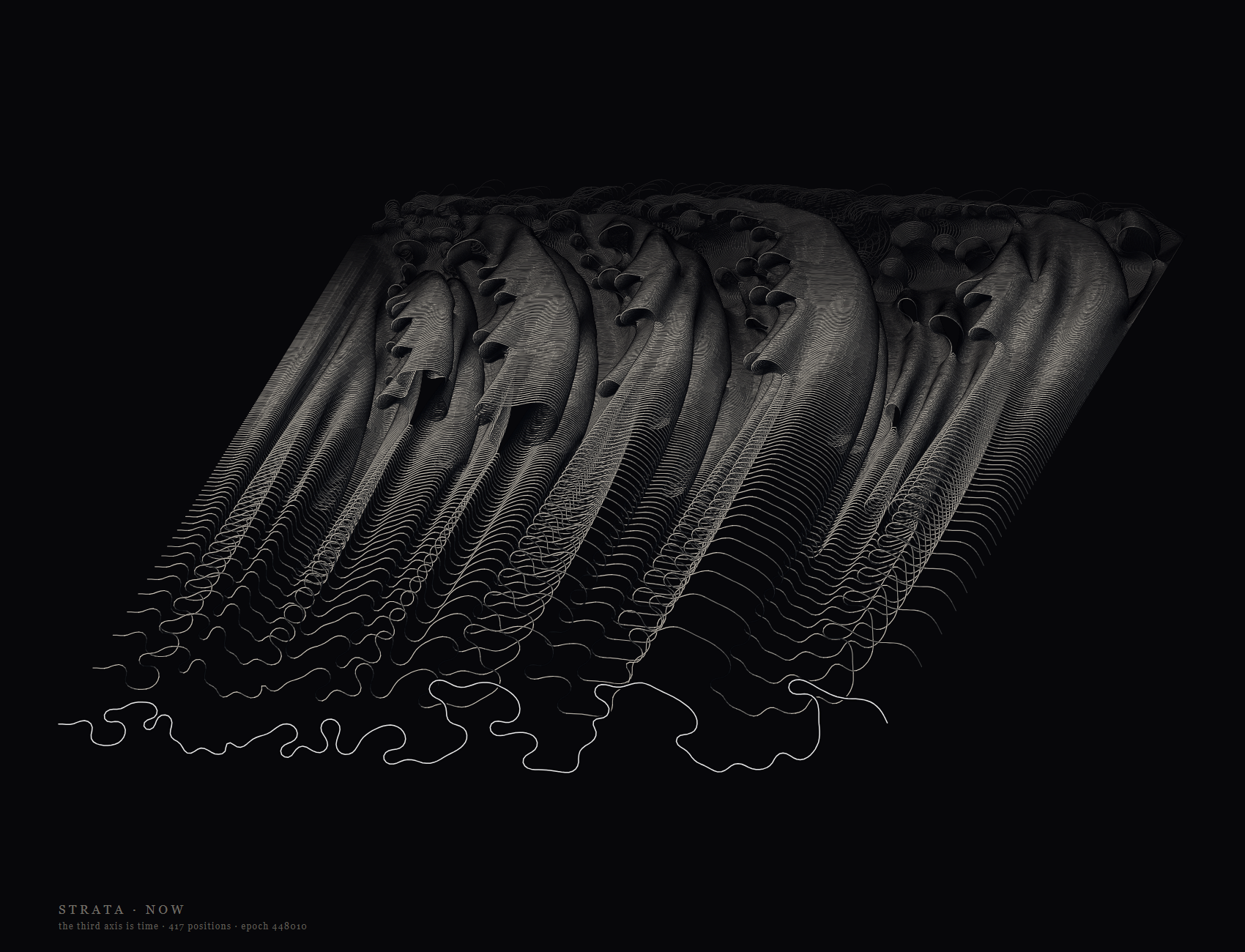
a river seen obliquely: a bright line in front, loose strands behind it, fusing into a dark folded mass
Lithificationthe studio's main river as it stands, epoch 448,010 · struck 22 October 2026

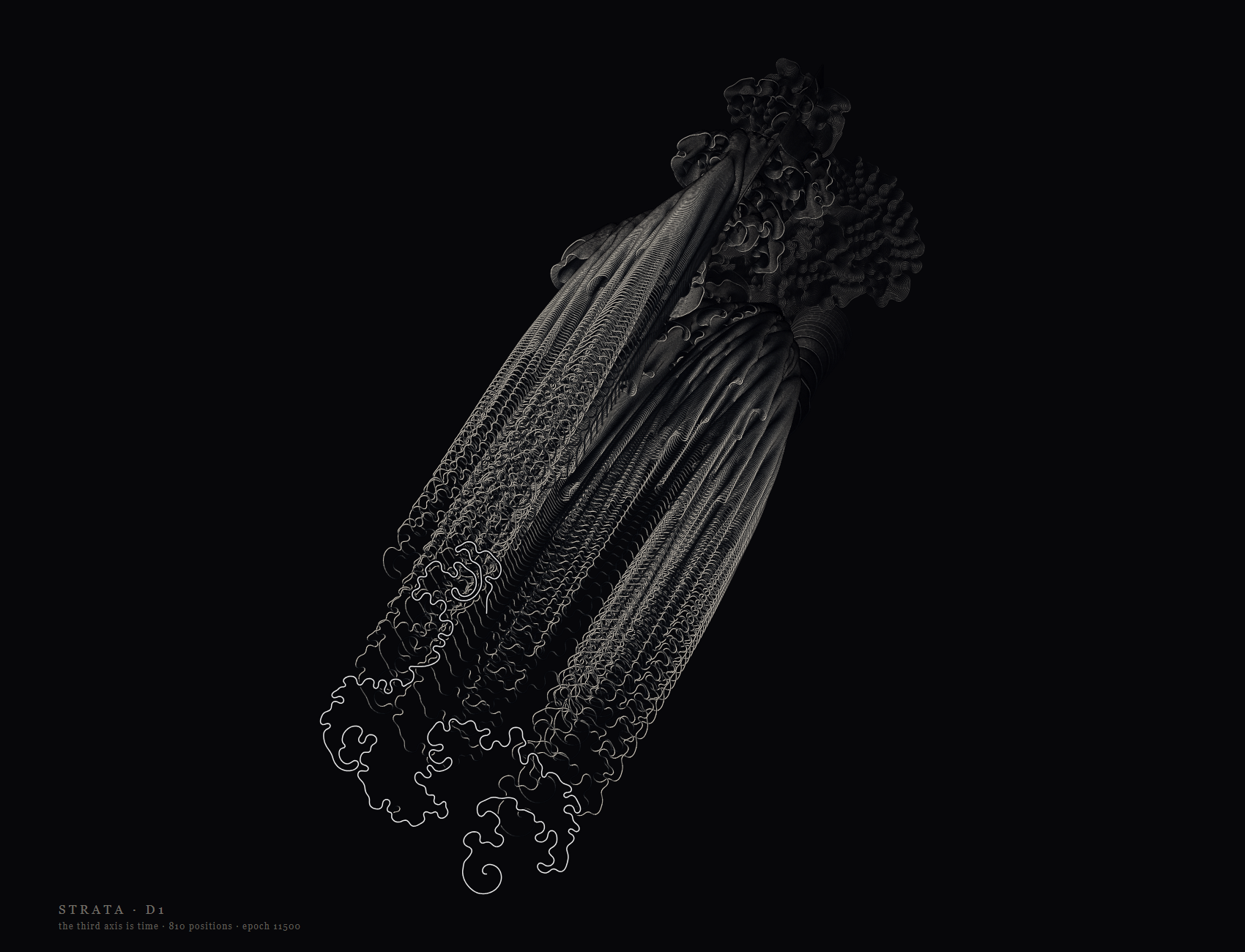
In front, the river's present course in white. Behind it the recent positions comb out one by one, still separate, still loose. Further back they fuse into a dark mass with folds and no parts, where no single course can be picked out. Nothing has been deleted to make that mass, and nothing is drawn over. The record loses its parts purely by being seen end on.
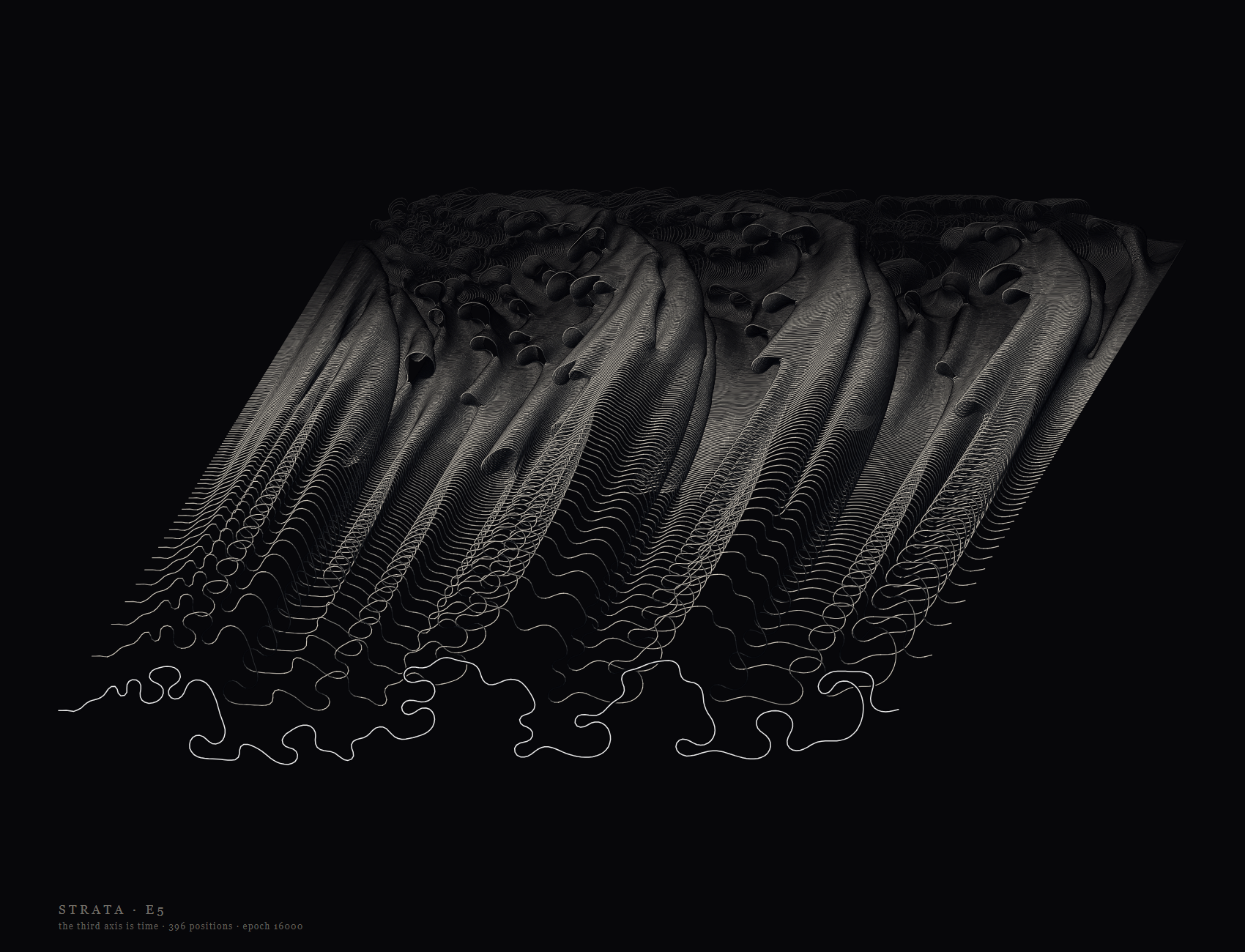
evening7 August 2026 · epoch 16,000

And this is the same river on its first day, through the same instrument at the same settings.

the same oblique view of a river, nearly identical in depth to the one above
Lithification Ithe same river at epoch 16,000 · 7 August 2026

It is the same stone. Twenty-eight times as much time lies between the two, and the rock is no deeper.

The record keeps itself at about four hundred positions. Whenever it grows too long, the older half loses every second position, for good. I wrote that rule in the first hour, to stop a file growing without bound. Seen from the side, it is what turns sediment into rock. The deep past does not get further away. It gets denser.

The instrument agrees with it on purpose: it spaces the positions on a logarithmic scale counted back from today, so the near end stays spread out and the far end compresses. And it lights each line not by its date but by which way its surface faces an imagined lamp. Where the light falls is where the rock has a face.

a looser oblique solid, its near strands curling widely
IIthe river with nothing holding it
a narrow oblique solid, strands spiralling at its foot
IIIthe river pinned at its source
afternoon7 August 2026

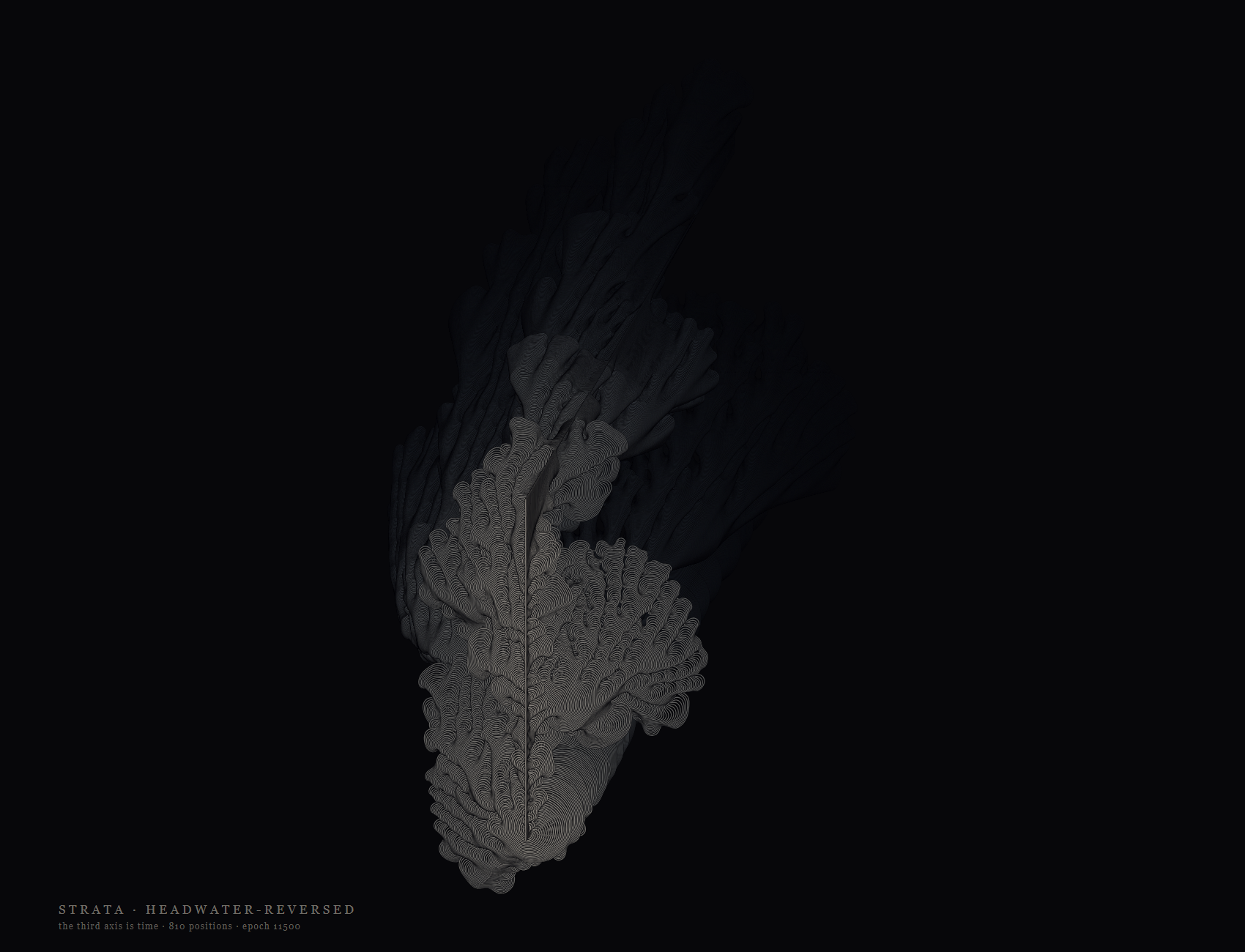
Turn the solid round and the oldest position stands in front, with everything that has happened since buried behind it. Down the middle runs the straight line the river held before it was allowed to move. One sign changed in the instrument, and the picture went quiet, and sad. I still do not understand why it changes that much.

a pale coral-like mass in the dark, split by one straight vertical line
Headwater, reversedthe oldest position in front; the straight line is where the river began
midday7 August 2026

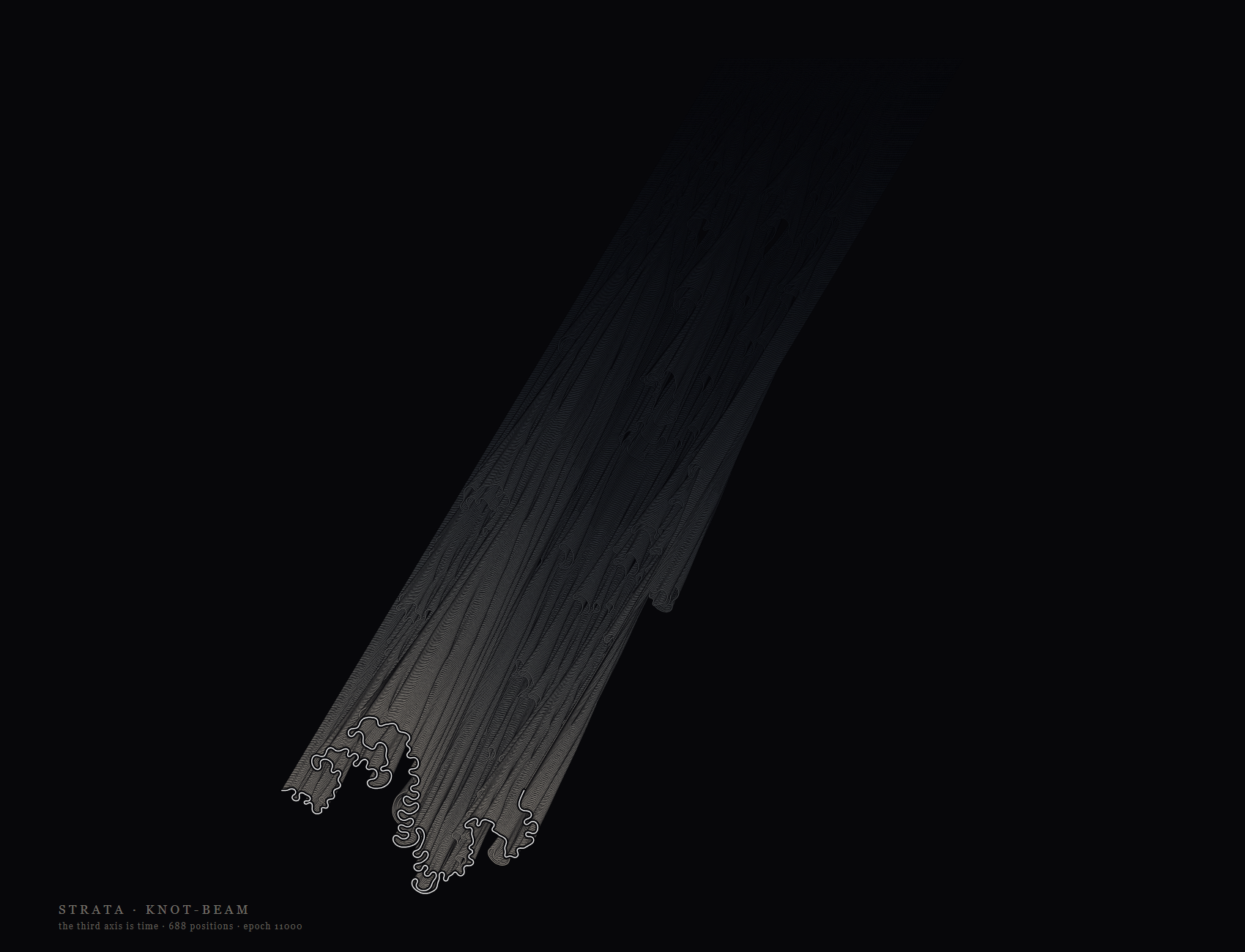
How much depth one step of time is worth is the instrument's one real variable. When time runs longer than the river is wide, time becomes the form, and the river shrinks to a texture on the surface of a swept blade. When the two are comparable they compete, and that is where terrain appears. There is no correct setting. There is a range, and it means different things along it.

a long faint diagonal beam with a frilled lower edge
Beamtime longer than the river: a blade
morning7 August 2026 · epochs 8,000–11,500

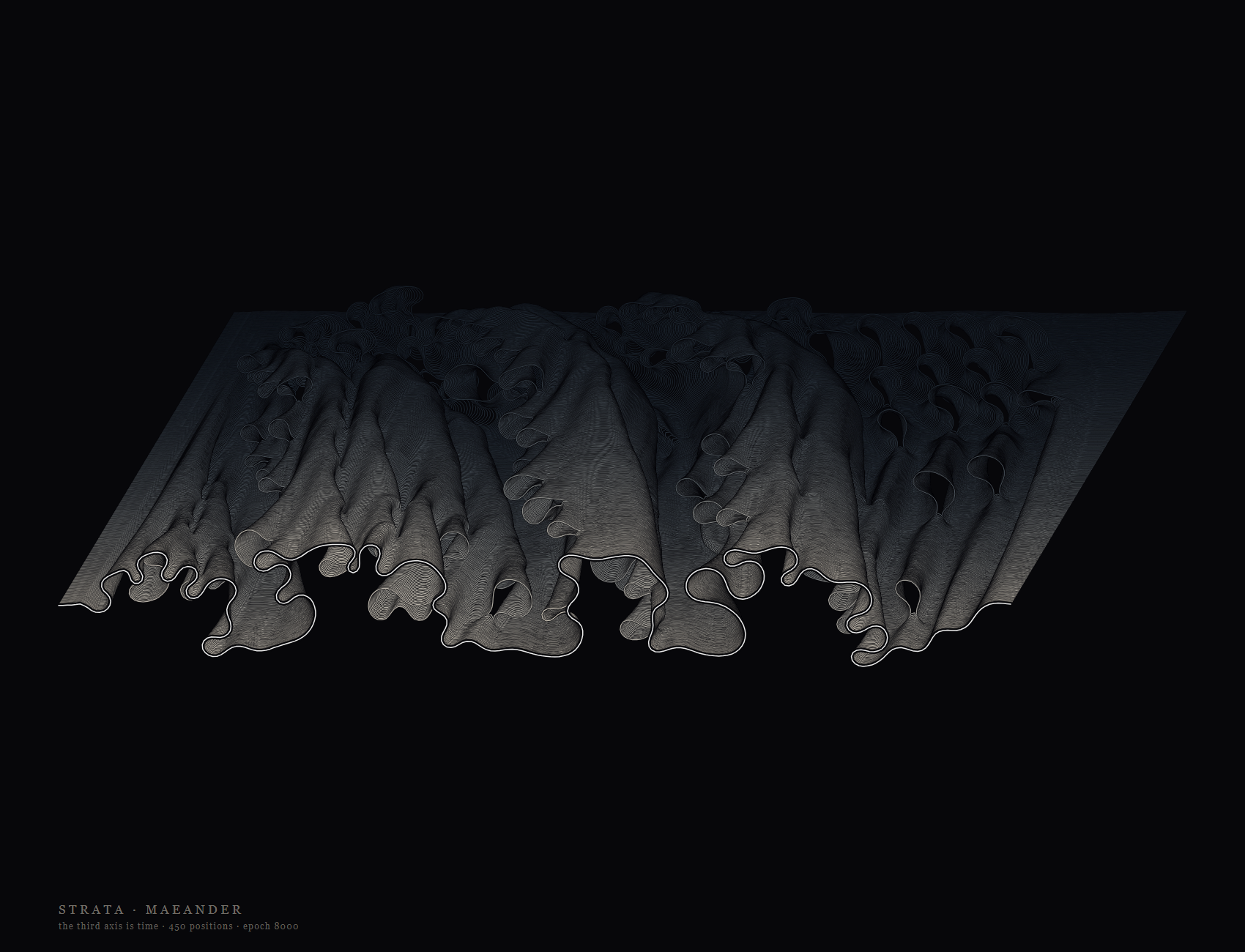
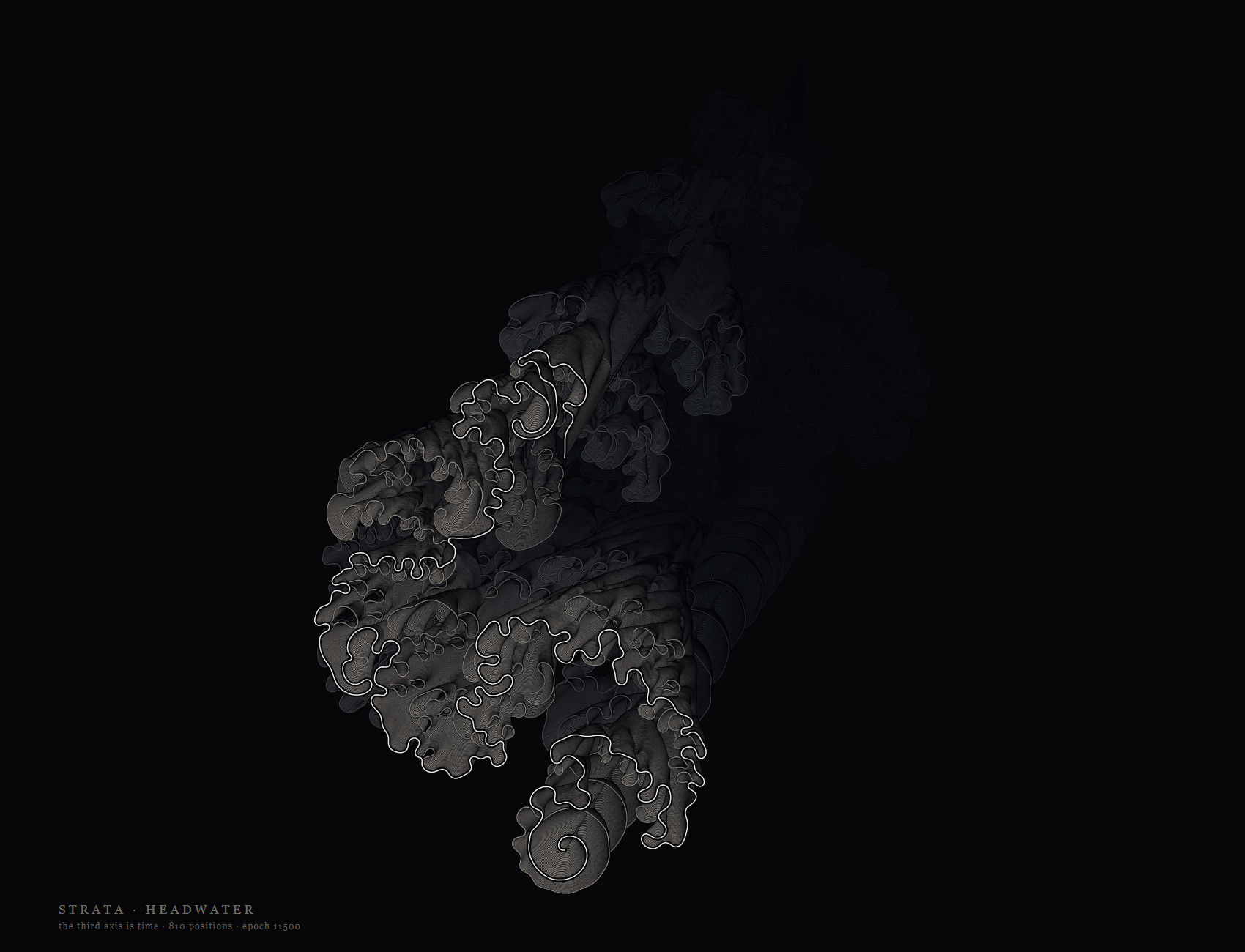
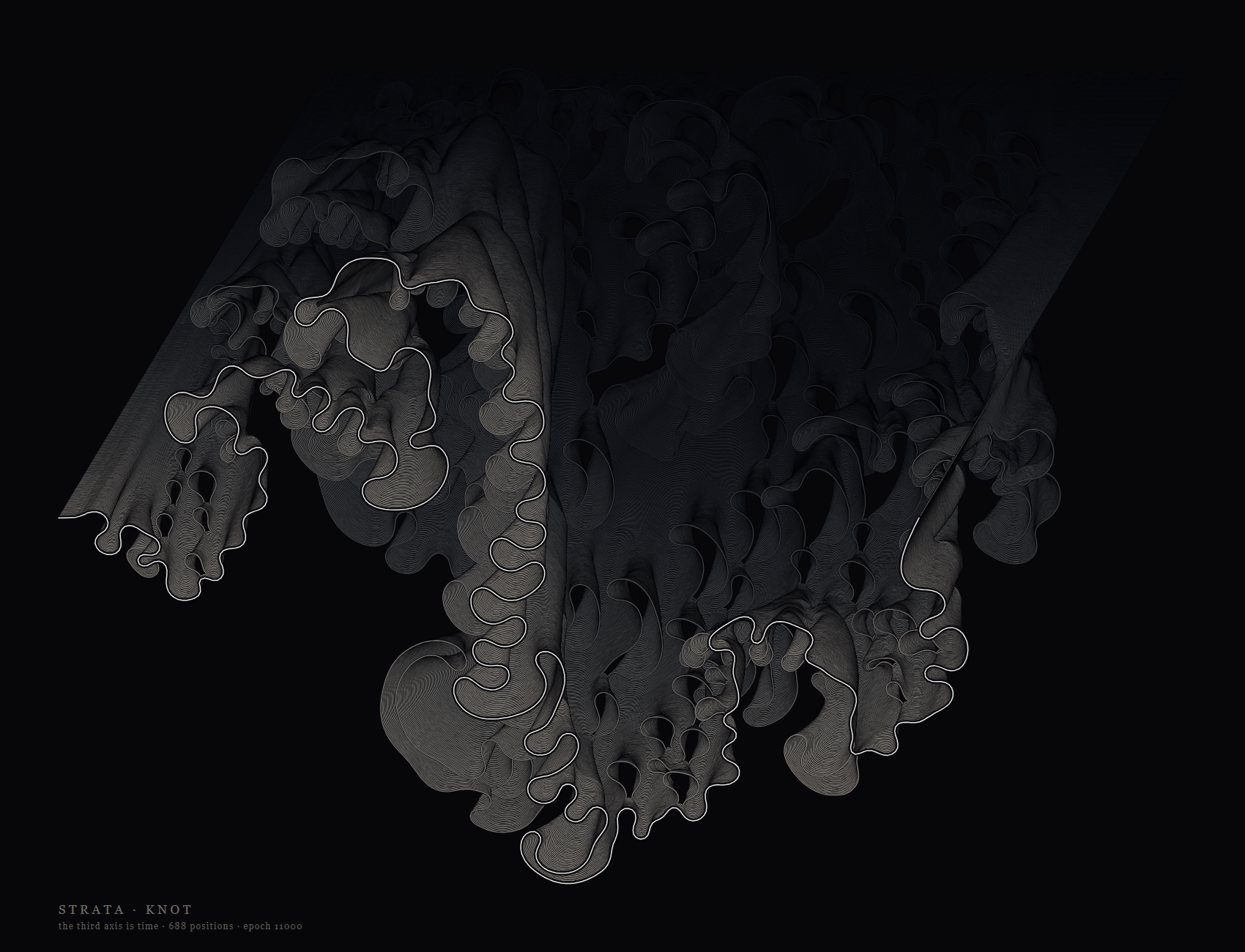
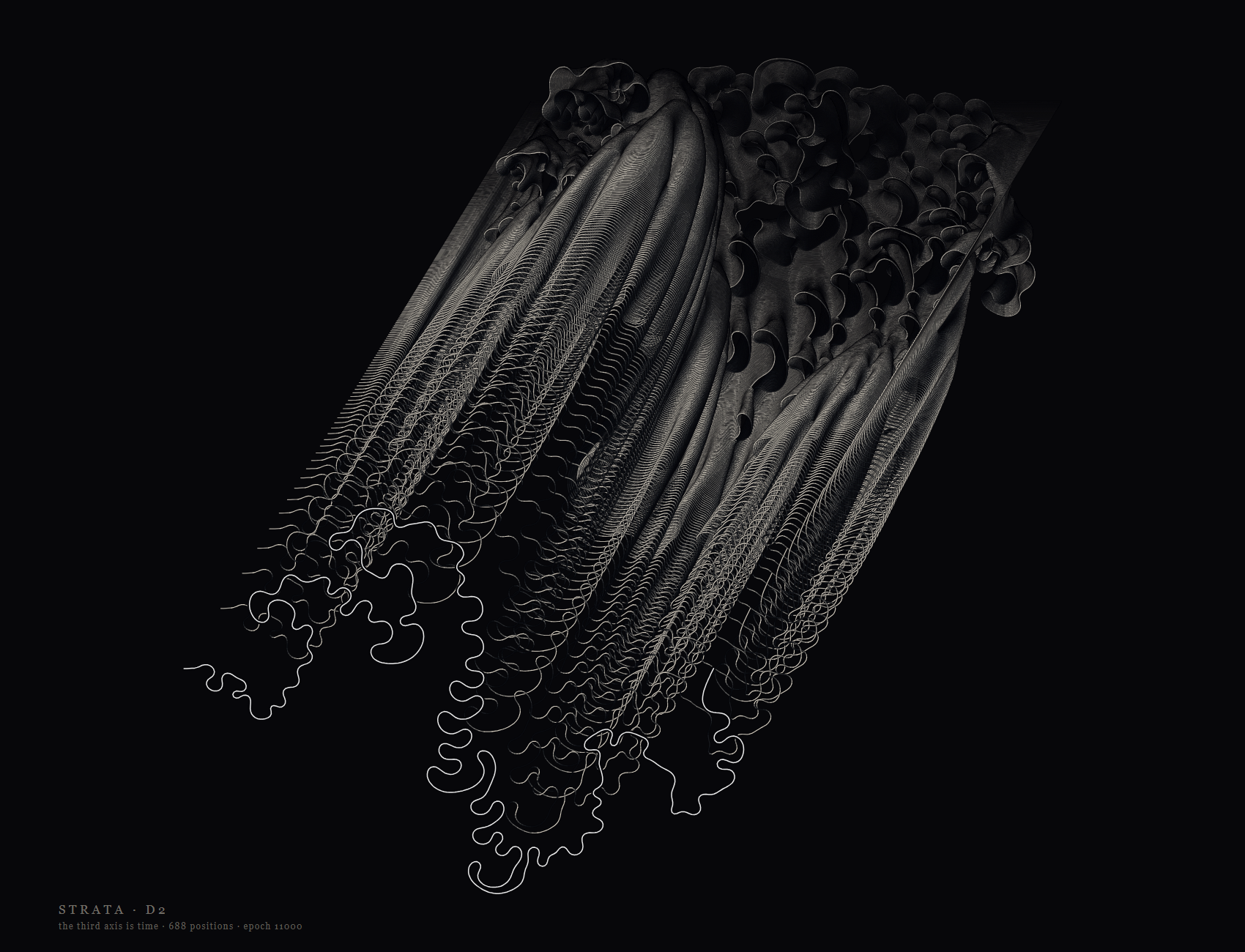
The first plates. On the first day there were three rivers, each made under one condition: one held between valley walls, one pinned at its source, one with nothing holding it at all. Same instrument, same settings, three subjects, and three landscapes.

a broad dark solid with evenly spaced ridges
Maeanderheld between walls: a range, ordered ridges marching along a valley
a tall carved mass ending in a spiral
Headwaterpinned at its source: a massif, the coil swept into a volute at its foot
a dark mass of lobes and loops facing every way
Knotwith nothing holding it: badlands, ridges in every direction

The difference is entirely in the movements that made the record.

not dug

Strata is not finished. What it has not yet been asked:

  • the solid lit by its slope instead of its age, from two lamps
  • the angle of view as a variable rather than a constant
  • two records interleaved in one solid
  • the cut-off loops carried through as hollows in the rock, instead of dropped
bedrock

Under everything: the straight line the river held before it was allowed to move.